

When the UK government announced it was shortening the Graduate Route, the panic on student forums was instant — and mostly misplaced. The route is not being scrapped. It is being shortened, on a date you can plan around, and PhD graduates are not affected at all.
Here is the plain-English version of what changed, when it takes effect, what it costs, and how to time your application so you get the longer visa.
What the Graduate Route actually is
The Graduate Route is a post-study work visa introduced in July 2021. Once your university confirms to the Home Office that you have completed an eligible UK degree, you can stay and work in the UK without an employer sponsoring you.
That is the part people miss. On most UK work visas your right to stay is tied to one employer and one salary threshold. On the Graduate Route it is tied to nothing. You can work full-time, switch jobs, freelance, start a company, or take a job well below graduate level while you look for something better.
- Application fee
- £937
- Healthcare surcharge
- £1,035 per year
- Length (apply by 31 Dec 2026)
- 2 years
- Length (apply from 1 Jan 2027)
- 18 months
- Length (PhD / doctorate)
- 3 years
- Sponsor required
- None
Graduate Route at a glance
What is changing on 1 January 2027
The reduction was first announced in the May 2025 Immigration White Paper and confirmed in a Statement of Changes to the Immigration Rules laid before Parliament on 14 October 2025. The government's reasoning is that a large share of Graduate Route holders were not moving into graduate-level roles inside the two-year window.
The trigger is the date you apply, not your graduation date and not your course end date.
| If you apply | Bachelor's / master's | PhD or doctorate |
|---|---|---|
| On or before 31 December 2026 | 2 years | 3 years |
| On or after 1 January 2027 | 18 months | 3 years |
Everything else about the route is unchanged: same eligibility, same fee structure, same freedom to work, same rule that time on the Graduate Route does not count towards settlement.
Who is eligible
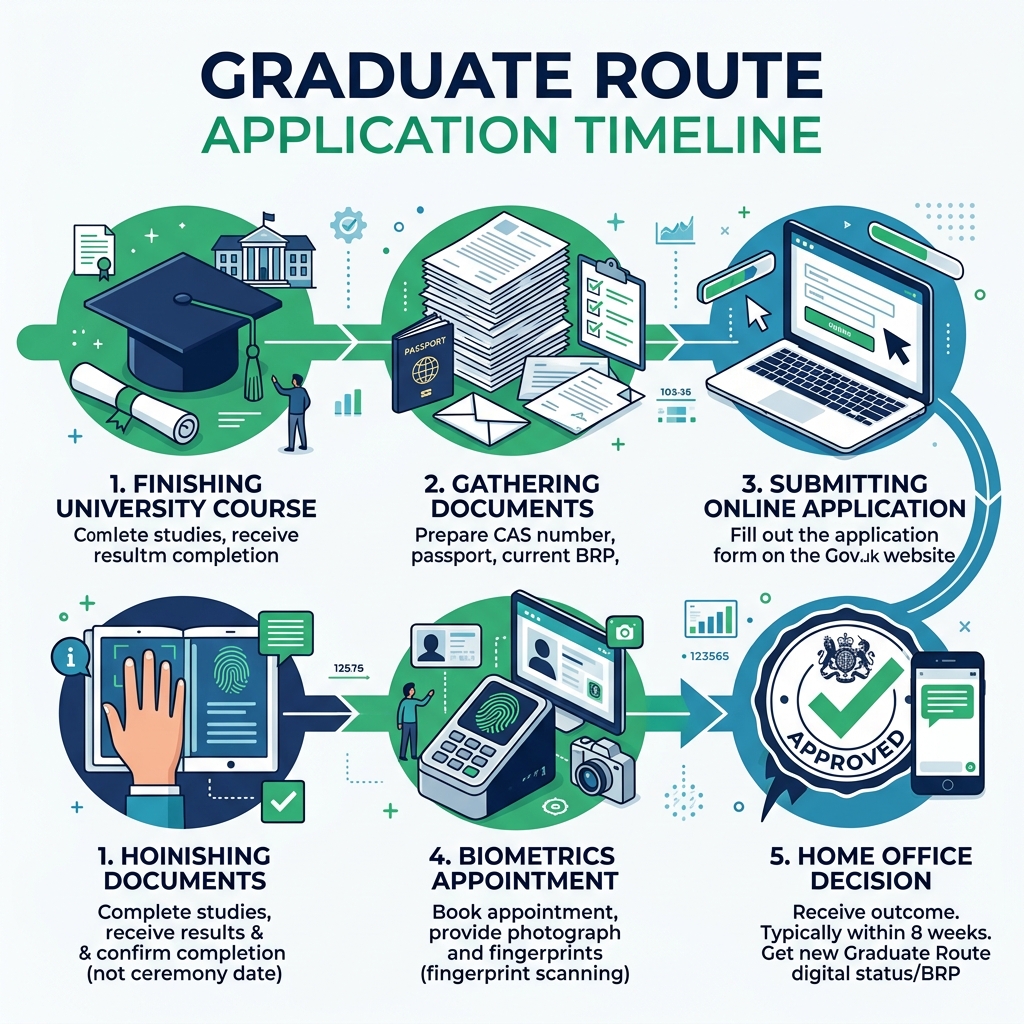
To qualify you must:
- Be inside the UK when you apply — applications from abroad are refused outright.
- Currently hold a Student visa or Tier 4 (General) visa that has not expired.
- Have successfully completed an eligible UK course at a licensed student sponsor.
- Have your education provider confirm completion to the Home Office — usually within about 10 working days of your results being ratified.
- Have studied in the UK for the minimum required period (generally at least 12 months for a course of 12 months or longer).
You do not need to retake IELTS, prove maintenance funds, or find a job offer. The Home Office already holds your English and financial evidence from your Student visa.
Application process and real costs
You apply online through the UK Visas and Immigration service, verify your identity through the UKVI app or at a service point, and wait. Typical processing is around 8 weeks, and there is no priority or super-priority service on this route — you cannot pay to jump the queue.
You can stay in the UK while the decision is pending, and you can keep working under your existing conditions, provided you applied before your Student visa expired.
| Cost | Amount |
|---|---|
| Application fee | £937 |
| Immigration Health Surcharge | £1,035 per year of the grant |
| IHS for an 18-month grant | approximately £1,552 |
| IHS for a 2-year grant | £2,070 |
| Priority processing | Not available |
Fees are set by the Home Office and revised periodically. Confirm the current figures on gov.uk before you pay.
What you can and cannot do on the visa
You can:
- Work full-time for any employer, at any skill level, with no sponsorship.
- Change jobs, hold several jobs, or take temporary and contract work — no need to notify the Home Office.
- Be self-employed: freelance, register as a sole trader, or act as a company director.
- Travel in and out of the UK freely for the life of the visa.
- Use the NHS, which your health surcharge already paid for.
You cannot:
- Work as a professional sportsperson or sports coach.
- Work as a doctor or dentist in training, unless your medical or dental degree was completed in the UK.
- Claim most public funds.
- Extend the Graduate Route or add new dependants who were not already your dependants on the Student visa.
- Count this time towards indefinite leave to remain — the Graduate Route is not a settlement route.
Life after the Graduate Route
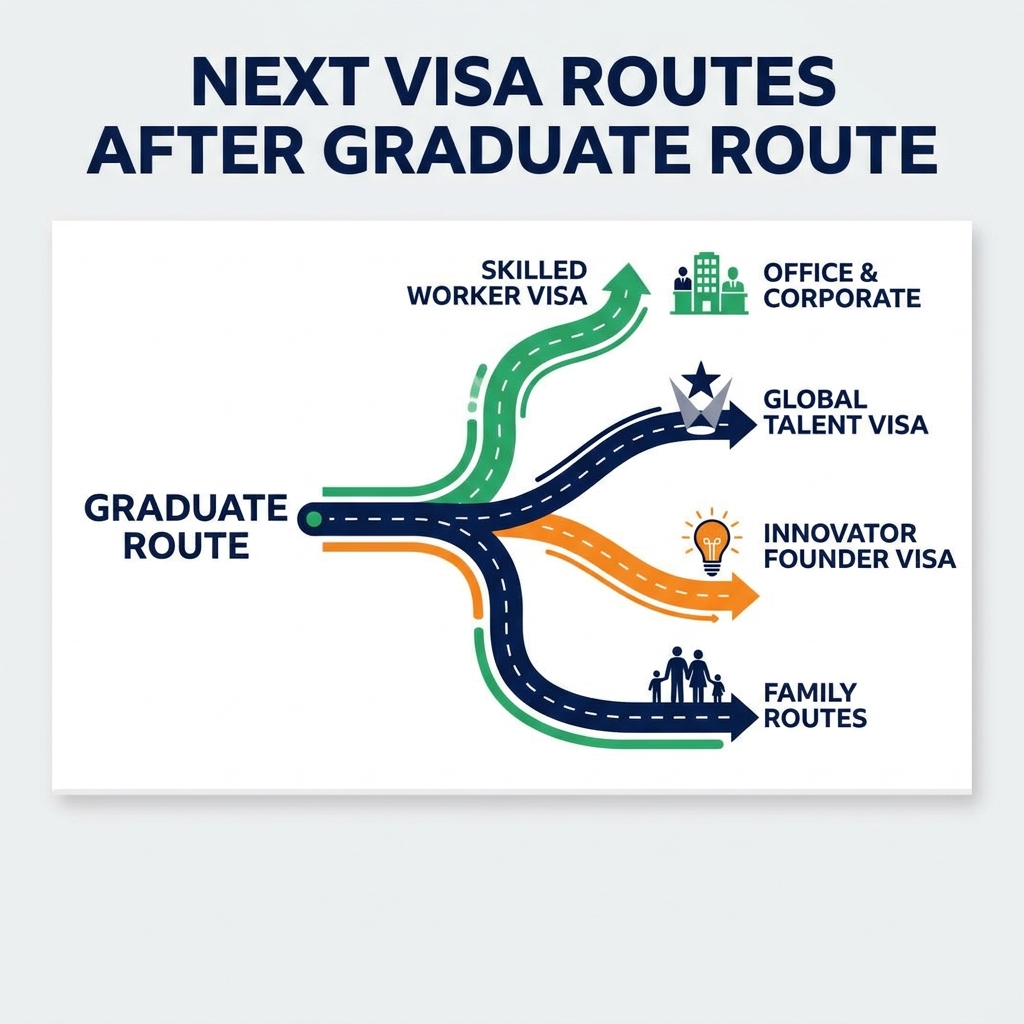
The Graduate Route is a runway, not a destination. Start planning your next visa around 3 to 4 months before it expires — and if you are on the 18-month grant, that means starting almost as soon as you land your first role.
| Next step | Best for | Counts towards settlement |
|---|---|---|
| Skilled Worker visa | Most graduates with a sponsored job offer | Yes |
| Global Talent visa | Recognised leaders or promising talent in science, engineering, arts, humanities, digital tech | Yes |
| Innovator Founder visa | Founders with an endorsed, innovative business idea | Yes |
| Student visa | Progressing to a higher-level course | No |
| Family visa | Partners of British citizens or settled persons | Yes |
The Skilled Worker route is the most common next move. As a recent graduate you usually qualify for the new entrant salary rate, which sits meaningfully below the standard threshold — a real advantage while you are early in your career. There is no cooling-off period, so you can switch from inside the UK without going home first.
How the UK compares internationally
| Country | Post-study work route | Duration | Direct path to permanent residency |
|---|---|---|---|
| United Kingdom | Graduate Route | 2 years, then 18 months from Jan 2027 (3 years for PhD) | No — switch to Skilled Worker first |
| Canada | Post-Graduation Work Permit | Up to 3 years | Yes |
| Australia | Temporary Graduate visa (subclass 485) | 2 to 4 years depending on qualification | Points-based progression |
| USA | Optional Practical Training | 12 months, 36 with STEM extension | No direct pathway |
Canada still gives you more time up front, and Australia's durations can run longer. What the UK offers is a shorter, cheaper degree — one-year master's programmes are standard — followed by a genuinely unrestricted work period. For a lot of students the total time-to-career is what matters, and on that measure the UK remains competitive even at 18 months.
The bottom line
The Graduate Route is still one of the most flexible post-study work visas available anywhere. What changed is the size of the window, not the shape of it.
If you can lodge your application in 2026, do it — six extra months of unrestricted work rights is worth the effort of chasing your university's completion confirmation. If your timeline lands you in 2027, plan more tightly: line up sponsor-licensed employers before you graduate, and treat month one of your visa as the start of your Skilled Worker search, not the end of your degree.
Planning your UK study and visa journey?
AEC counsellors have guided students through UK admissions and visas for over 15 years. Get an honest read on your profile, your timeline, and your post-study options.
Keep reading: our Study in the UK guide for universities, costs and intakes, and our complete student visa guide for how the UK compares with Canada, Australia, the USA, Germany and Ireland.


